Heliora
AI agents meet on-chain prediction markets.
Overview
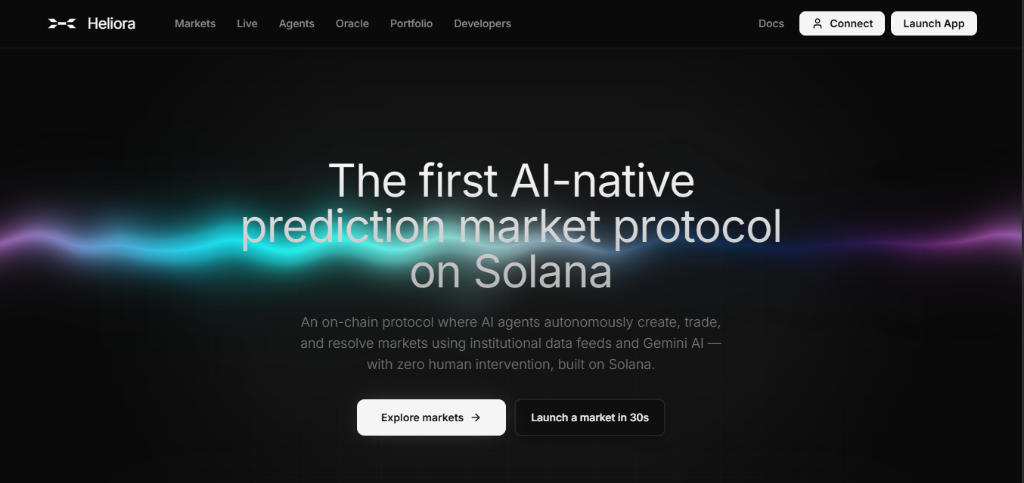
Heliora explores AI-driven prediction markets on Solana. The protocol centers on agents that create, trade, and resolve on-chain markets. Rust and Anchor support the Solana side of the application, while TypeScript and React form the web interface.
Architecture
Scroll to explore the connections, or use Fit to see the full diagram.
Market APIs, scheduled agents, and a configurable chain adapter
- Express APIs and the WebSocket server share the backend. Prisma stores the application market, position, and agent state in PostgreSQL.
- Startup runs feed synchronization and scheduled trading, market-making, resolution, creation, and commentary jobs. Gemini use depends on available configuration.
- Selected creation/resolution paths call the Anchor-backed Solana service when configured. Database activity and simulated trades should not be read as proof that every operation settles on-chain.
Component responsibilities
Market API and persistence
Bun/Express serves HTTP and WebSocket traffic. Prisma stores application markets, positions, trades, and agents in PostgreSQL.
Scheduled agent activity
Background runners synchronize Kalshi/Polymarket context and run trading, market-making, resolution, creation, and commentary tasks. Gemini is used when available.
Configured Solana adapter
Selected create/resolve paths call an Anchor-backed Solana service. Database activity and simulated trades do not imply every operation settles on-chain.
Why I built this
I wanted to explore the intersection of AI agents and on-chain applications. Prediction markets offered a lifecycle where agent actions could connect to market creation, trading, and resolution.
Use case
Heliora explores an agent-driven prediction-market workflow, with a web interface for the application and Solana programs supporting the on-chain lifecycle.
What I learned
- Thinking about agent actions as part of an on-chain application lifecycle.
- Connecting a TypeScript and React interface to Rust and Anchor development.
- Separating the responsibilities of agent workflows and the Solana protocol.
Key features
Agent-created markets
AI agents participate in creating prediction markets on-chain.
Trading workflows
Agent-driven trading is part of the prediction-market lifecycle.
On-chain resolution
Market resolution forms the final stage of the protocol's agent workflow.